
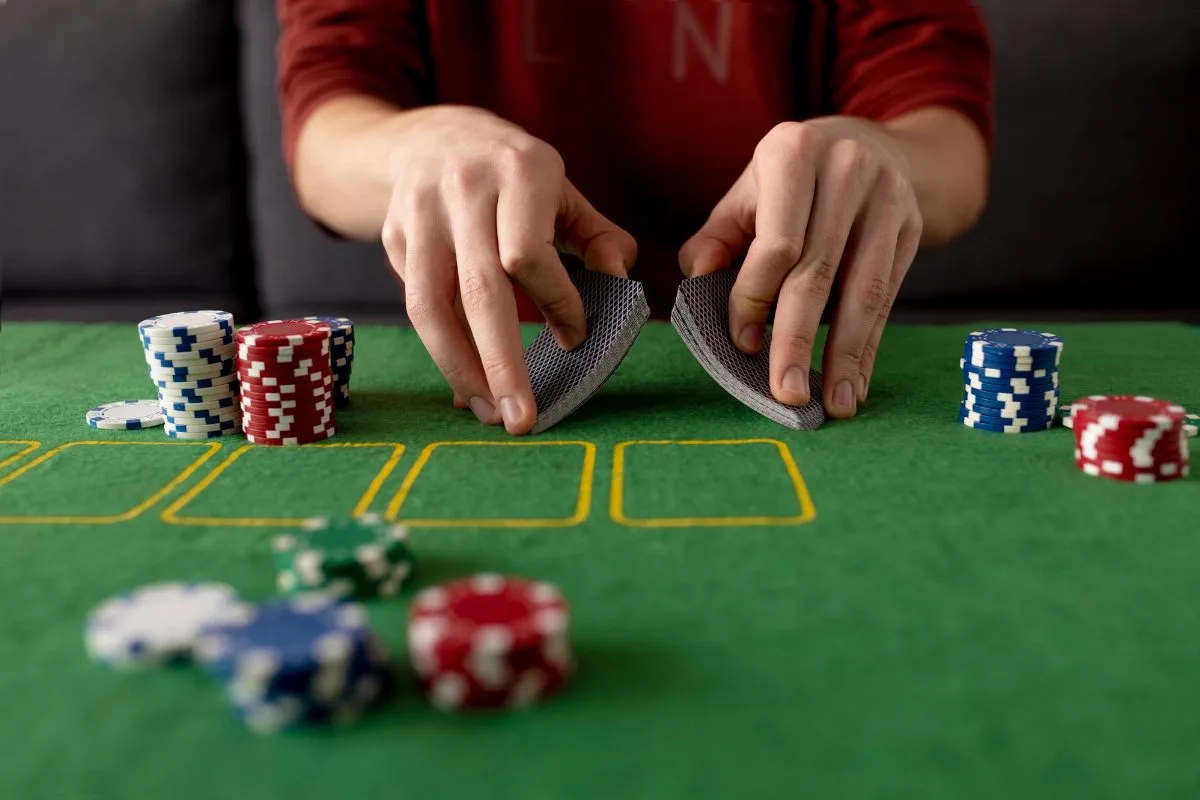
Different blackjack tables, both live and land-based, have different rules affecting player return.
There Is No Single Live Blackjack Ruleset
A live blackjack table is not a single universal game with a fixed ruleset and house edge. The live-category name describes a format and a presentation style, not a mathematical specification.
Most rule variations can be separated into a few main categories.
First, there are core blackjack rules that change the expected return and, in some cases, correct strategy:
the rule governing how blackjack pays,
whether the dealer hits or stands on soft 17,
the number of decks used,
the availability of the double-down action,
the limits on when a player can split or resplit, and
whether and when a player can surrender.
Next, there are procedural differences in how the dealer checks for blackjack. If the game uses a hole card, the dealer may peek for blackjack before proceeding to resolve the player's hand; if the game follows a no-hole-card procedure, the dealer typically checks for blackjack after all players have acted, potentially resulting in additional wagers lost if the dealer then has blackjack.
The maximum bet, minimum bet and table limits are notable differences between tables, though these are elements of table configuration and commercial positioning, not strategic or mathematical rule changes.
Wagering on side bets including 21+3, Perfect Pairs or Hot 3 is separate from the core game but also changes the betting options a player should be aware of before playing.
Live blackjack rulesets also differ in features that change the flow or capacity of the game rather than its underlying mathematics:
Maximum number of players allowed per table, differing between fixed-seat tables and unlimited-seat formats,
The designed game pace and decision clock, ranging from simultaneous decision play to, if available, automatic resolution of hands using predefined strategies, and
Special rules like automatically awarding a win to a player with six cards totaling 21 or less.
The Rules That Matter Most
Blackjack Pays 3:2 or 6:5
If the table displays blackjack payouts in writing, this will be one of the first rules you should verify. Under Wizard of Odds' baseline rules, blackjack paying 6:5 reduces expected player return by approximately 1.39 percentage points compared to 3:2.
If you don't know where to find an online casino, the Danske Casinos website offers a wealth of information on gambling, including casino reviews and details about bonuses and games. As a result, even a new player can easily grasp a lot of new information.
Dealer Stands or Hits on Soft 17
Blackjack games specify whether a dealer's soft 17 is a standing total or a hitting total. Wizard of Odds calculates that a dealer hitting soft 17 reduces player expected return by 0.22 percentage points; beyond the edge, this rule also increases the dealer's bust probability by approximately 0.4027 percentage points in an eight-deck US-rules calculation, to 29.99%.
One vs Eight Decks
The increase in decks generally reduces the player's expected return when other rules remain unchanged. Relative to an eight-deck game, Wizard of Odds calculates that moving to one, two, four, or six decks increases player expected return by 0.48, 0.19, 0.06 and 0.02 percentage points, respectively — but this calculation is based on the other core rules remaining unchanged.
Double-Down Rules
Almost every conventional blackjack game allows at least an opportunity for a double-down action, but some tables restrict it more sharply than others, and some blackjack variants make it impossible:
Players can have the option to double after splitting (DAS), or be prohibited from doubling after splitting.
Players may be able to double only on 10 or 11, or only on 9, 10 and 11, or on any first two cards.
Doubling after splitting may be restricted for particular hands or variants.
Some rulesets even remove the double-down action entirely.
Splitting Rules
For games that allow the splitting of pairs, a series of additional rules govern that action. These include the maximum number of hands resulting from a split (including what happens if a split results in another pair), whether aces can be resplit, whether split aces get only one card, and whether doubling after a split is allowed.
The number of permitted splits depends on the blackjack variant and its specific rules. A licensed casino listed on the site may offer several blackjack tables with different limits on resplitting pairs.
There are blackjack variants that entirely remove the split action.
Surrender
Live blackjack games can make surrender available to players, or remove it entirely. For products that offer surrender, it could be late surrender, meaning the player can surrender after seeing their own two cards and the dealer's up card, provided the dealer does not have blackjack.
That late surrender option at the table level is meaningful: Relative to Wizard of Odds' baseline, late surrender adds approximately 0.08 percentage points to player expected return.
Hole Card, Peek and European No-Hole-Card
European no-hole-card (ENHC) blackjack follows a different procedure from US-style games around checking the dealer's hand. Instead of receiving a hole card, the dealer in no-hole-card blackjack receives the second card after the players have acted and then determines whether the final hand is blackjack. If the dealer's up card is an ace or a ten-value card:
US hole-card games generally check for dealer blackjack before players act, although some variants use a more limited peek procedure,
whereas the ENHC procedure checks for the dealer's blackjack after players act on their starting hands, potentially causing additional wagers made by splitting or doubling to be lost.
Why Live Tables Are Designed Differently
Different Tables Target Different Stakes
Providers offer tables with different minimum and maximum bets not only to maintain a range of stakes, but also to support the commercial requirements of different operators. A higher table limit does not override bonus restrictions: CanadaCasinoTop lists wagering requirements and maximum bonus bets that may be lower than the table's permitted stake. Regardless of the specific rules, the table limits are an important, considered element in designing a product or range.
Providers Build Different Blackjack Products
Some live casino providers offer multiple different takes on the blackjack table. Evolution's standard live blackjack tables support up to seven seated players at one dealer; its Infinite Blackjack format gives each player the same starting two cards but then allows the table to expand beyond seven seats, for example; its Easy Blackjack rules allow players to wager on five specific hand totals rather than playing their own cards; and its Lightning Blackjack uses RNG-generated multipliers and an additional fee that change the return of the main-game wagers.
Some Variants Are Designed for More Players
Blackjack players are not always dealt the same two cards, but under Infinite Blackjack from Evolution, they are. Instead of dealing separate starting hands to every player, Evolution's Infinite Blackjack gives each player a common initial two cards and then allows them to make individual decisions on those cards, letting the table accommodate an unlimited number of players.
Players with the common starting hand can choose different actions using the Hit, Stand, Double or Split options available to that hand.
Other tables offer more traditional gameplay where seat availability remains fixed, including conventional no-hole-card games.
Some Tables Are Designed for Faster Rounds
Speed Blackjack from Pragmatic Play includes features that alter how quickly players can make decisions during each round, not necessarily the mathematical rules at the heart of the game.
Between simultaneous decision offers and automatic player decisions, Pragmatic Play's June 2022 Speed Blackjack launch reported a reduction of up to 30 percent in the length of a game round.
Do not confuse speed features with rules that meaningfully affect player edge: even a table where players can make simultaneous decisions or use automatic actions still operates under a specific mathematical ruleset.
Operators Can Configure Parts of the Product
These are product settings, not necessarily independent licensing controls.
Provider documentation outlines the array of configurable features that different products offer.
When tables have these settings exposed, the provider makes them available for an operator to adjust within the supported configuration.
This does not conclusively mean that every casino has control over every possible live blackjack rule.
Regulation Is Another Reason Tables Can Differ
Blackjack Live operates under its own approved specification, for example, listed by the Nevada Gaming Control Board, including its own rules and reference documents. This is true of other distinct blackjack products such as IGT Dynasty Live Blackjack and GameAce Live Blackjack, not to mention various blackjack variants with additional poker-style wagers.
Rules Are Approved at the Game Level, Not Universally
Multiple rulesets can be approved by the regulator, retaining both common elements and meaningful differences.
Illustrative example: While IGT Dynasty Live Blackjack and GameAce Live Blackjack are both listed among Nevada's approved games, their individual rules and on-screen information must be assessed from their respective game specifications.
How Different Rules Change the House Edge
Rule change | Effect on player expected return |
|---|---|
Blackjack pays 6:5 instead of 3:2 | −1.39 percentage points |
Dealer hits soft 17 instead of standing | −0.22 percentage points |
No doubling after splitting | −0.14 percentage points |
Double only on 9–11 instead of any first two cards | −0.09 percentage points |
Late surrender allowed | +0.08 percentage points |
Single deck instead of eight decks | +0.48 percentage points |
European no-hole-card rules | −0.11 percentage points |
These effects compare one rule configuration with another. In one documented comparison, blackjack paying 6:5 instead of 3:2 reduces player expected return by approximately 1.39 percentage points, even when the other rules remain unchanged.
Where possible, compare the individual rule effects against the overall house edge.
The effects are calculated against the Wizard of Odds baseline of eight decks, dealer standing on soft 17, doubling allowed on any first two cards, doubling after splitting permitted, and splitting allowed to four hands.
Why Two Tables From the Same Provider May Still Differ
Some live blackjack products have more similar rulesets than others, even from the same provider. For instance, Evolution's standard Live Blackjack and Evolution's Infinite Blackjack both use eight-deck formats with a 3:2 blackjack payout and a dealer standing on soft 17, although other rules can differ regardless of the shared branding.
Other tables can have different numbers of decks, for example, or different availability of wagers or different dealer-provided side bet options or different treatments of Six Card Charlie.
This article does not claim that every variant has a better or worse overall return than another, but players should read the rules before playing, even at neighboring tables.
Core Rules vs Side Bets
Side bets like 21+3, Hot 3 and Bust It offer additional wagers. These bets are separate from the main blackjack hand.
Instant-decision features can change the pace of the game for players.
This section avoids assigning a single house edge to every blackjack format, especially to variants such as Easy Blackjack.
Special Live Blackjack Variants
Infinite Blackjack
Evolution's Infinite Blackjack deals each player the same two initial cards and then allows them to make their decisions individually.
Unlimited seats and shared starting cards distinguish the format.
Speed Blackjack
Pragmatic Play implements speed features like simultaneous decision offers that reduce decision time and can shorten the dealer's round.
Lightning Blackjack
Evolution's Lightning Blackjack adds a mechanic of randomly generated multipliers.
Multipliers ranging from 2x to 25x are awarded on winning scores for use in a subsequent round, while a separate 100% Lightning fee applies to the initial bet.
Easy Blackjack
This is the biggest departure from conventional blackjack gameplay.
Players wager on the outcomes of predefined hand totals of 16, 17, 18, 19 or 20 rather than receiving and playing individual hands.
How to Compare Two Live Blackjack Tables
Blackjack payout — 3:2 or 6:5.
Dealer rule — stands or hits on soft 17.
Number of decks — single, double or multiple decks.
Double-down restrictions — allowed totals and post-split rules.
Splitting rules — resplitting, aces and maximum hands.
Surrender — early, late or unavailable.
Hole-card procedure — dealer peek or no-hole-card rules.
Side bets and special features — optional wagers, multipliers and automatic wins.
Table limits and pace — minimum bets, maximum bets and decision timers.
The sequence should be consistent when comparing tables.
Rules and game versions, like gambling laws, cannot be determined conclusively from a single playing session.
Do Different Rules Require Different Basic Strategy?
Several major rule changes affect the optimal strategy for a player.
21+3 can materially affect the return of a player's total wagers, but it is separate from the basic strategy for the main blackjack hand.
Infinite Blackjack, in which the first two cards are shared by players, introduces a shared starting hand while individual actions continue to follow the core game rules.
This information is valuable for players comparing blackjack tables.